The outer sock is part of the playing kit
The long sock most people recognise as a football sock has several jobs. It covers the lower leg, helps keep a shin guard in position and gives the team a consistent appearance. In a match, its colour also helps distinguish one side from another. A sock that stays up without bunching is easier to play in than one that needs constant adjustment.
Fit matters more than thickness alone. A sock that is too loose can slide down or gather around the ankle; one that is too tight may feel uncomfortable over a shin guard. The foot section should sit smoothly inside the boot, with the heel in place and no folds under the sole. Some players choose a full-length team sock, while others use a footless team sleeve over a separate sock. The latter arrangement gives players more choice over what sits against their foot, but its acceptability can depend on competition rules.
Grip socks address movement inside the boot
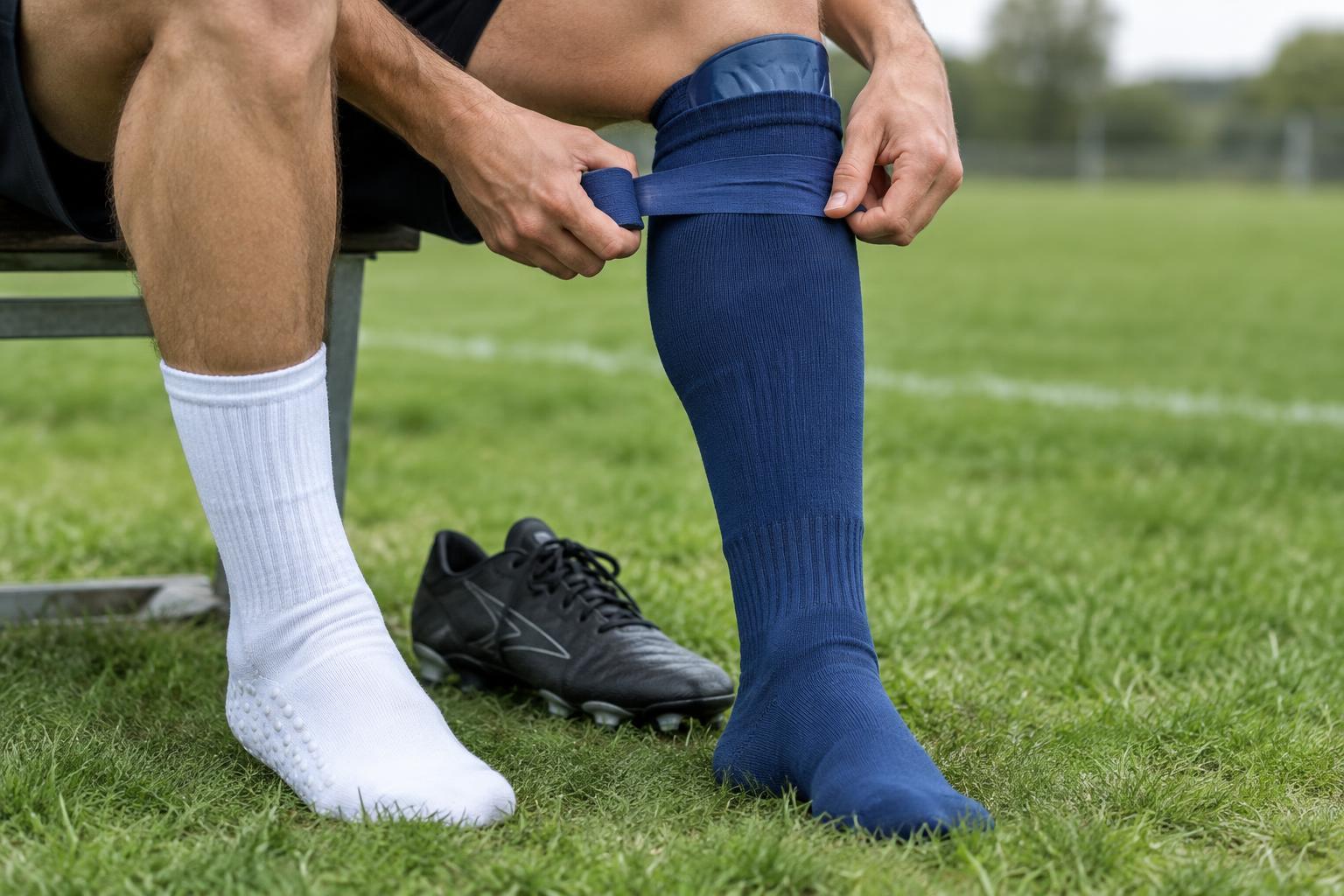
Grip socks have textured pads, often on the sole and sometimes on the outside of the foot, designed to increase friction between foot, sock and boot. Their purpose is to limit sliding during turns, stops and changes of direction. They are not a substitute for a properly fitting boot: if the boot is too large or the laces do not hold the foot securely, a different sock may not solve the problem.
The feel varies with the sock fabric, the shape of the boot and the player's preference. A grippy surface can feel secure to one player and distracting to another, especially if the sock changes how tightly the boot fits. Try a pair during training before relying on it for a match. Check that the toe seam and grip pads sit flat, and that the heel does not creep forward as you move.
Sock tape holds the outer layer in place
Sock tape is usually wrapped around the outside of the football sock to reduce slipping or hold fabric close to a shin guard. Some players place a band below the calf, around the ankle, or near the top of the guard. It works on the outer layers; it does not improve the fit of the foot inside the boot in the way grip socks are intended to.
Use only enough tape to do the job. A wrap that feels comfortable while standing may feel restrictive once the calf is working, and tape applied over a crease can make that crease more noticeable. Leave room for normal movement, avoid pulling the sock out of shape, and remove tape after playing rather than treating it as a permanent part of the kit. If a sock repeatedly falls down, a better-fitting sock or sleeve may be a simpler answer.
How players combine the three
One common setup is a full-length team sock over the shin guard, secured with tape if needed. Another uses a grip sock on the foot and a matching team sleeve on the lower leg. Some players cut the foot from a standard team sock to create a sleeve, then cover the join with tape. That can produce extra fabric around the ankle, so it is worth checking for bulk before stepping onto the pitch.
Start with the fit of the boot, shin guard and outer sock, then change one thing at a time. If the foot slides, check the boot and the sock inside it. If the shin guard shifts, check its fit and how the outer sock holds it. If the outer sock drops, consider its size before adding tape. Keeping each problem separate makes it easier to tell whether a new layer has helped.
Check the kit rules and keep it comfortable
Match requirements can differ by league and competition. Before using visible grip socks, a separate sleeve or external tape, check the kit guidance for that match. Colour requirements may apply to exposed socks or tape, and shin guards still need to be worn and covered as required. What works at training may not be suitable for a formal fixture.
The best setup is one you can forget about while playing. Put it on in the order you intend to use on match day, walk and turn in your boots, and notice any bunching, pressure or slipping. Football socks provide the outer kit layer, grip socks target movement within the boot, and sock tape secures fabric on the outside. Each has a distinct role; none needs to be added simply because other players wear it.