Start with how you plan to wear it
A football scarf has two jobs that do not always go together: keeping you comfortable and showing a design clearly. A thick scarf may feel welcome on a cold terrace but bulky on a mild day. A lighter one may be easier to wear with a jacket or carry in a bag, though it will provide less warmth. Before choosing a colour or slogan, think about the conditions in which you will use it most.
Also consider whether you want a scarf mainly for matchdays or for regular wear. Bold lettering and contrasting club colours are easy to see when a scarf is held up, while a simpler pattern may sit more naturally with everyday clothes. Neither approach is more authentic; the useful choice is the one you will enjoy wearing.
Understand the common constructions
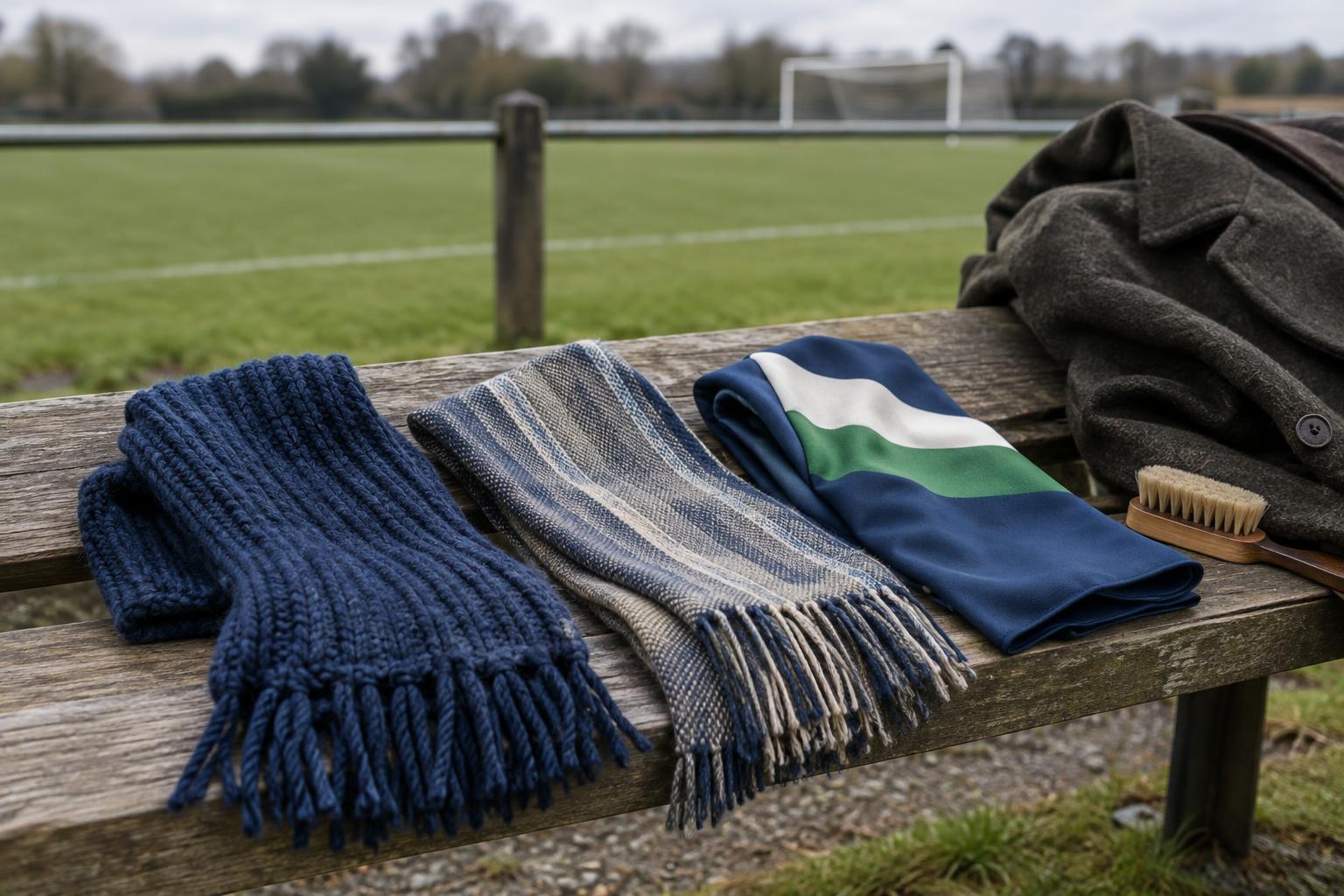
Knitted scarves are made from interlocking loops of yarn and often have a soft, flexible feel. Heavier knits can trap warmth, but thickness varies considerably. Check whether the edges lie comfortably against your neck and whether the fabric springs back after a gentle stretch. An open knit may catch on zips, bag straps or rough fasteners, so it can require a little more care.
Woven scarves are generally flatter and can carry detailed lettering or patterns on a relatively smooth surface. They may fold neatly under a coat, making them useful if you want colour without much bulk. Printed designs offer another route to fine detail, but their feel depends on the base fabric and the print. If possible, look at both sides: a design that is strong on one side may appear muted on the other when the scarf twists.
Fibre matters as much as construction. Wool and wool blends can feel warm but may bother sensitive skin. Acrylic is common in knit accessories and can be easy to handle, though it may feel different from natural fibres. Cotton can be pleasant against the skin but is not necessarily the warmest option when damp. Rather than judging by the fibre name alone, consider the scarf’s weight, texture and care label.
Check the details before you buy
Length determines how many ways you can wear a scarf. A shorter one may tuck into a jacket without leaving loose ends; a longer one gives you more room to loop it around your neck or hold it across your shoulders. Width affects warmth and visibility too. If buying in person, try your preferred wrap rather than assuming that every scarf with similar measurements will hang the same way.
Look closely at the parts most likely to show wear. Are the edges finished evenly? Are the fringes secure enough for normal handling? Do raised letters or patches feel comfortable when folded toward your neck? If you are buying a scarf with a club crest, check that its placement still looks right when the scarf is worn, not just when it is laid flat. These small details often matter more in use than they do in a product photograph.
Wear it without fighting the rest of your outfit
A scarf is an easy way to introduce club colours without dressing entirely in them. Against a plain coat or jumper, a high-contrast scarf becomes the focal point. If you are already wearing a bright football shirt, letting the scarf hang loosely or choosing one with a quieter pattern can keep the combination from feeling crowded. Personal style matters more than a fixed rule about which colours should be worn together.
For warmth, wrap the scarf so it sits comfortably rather than pulling it tight. Loose ends can get in the way when you are walking through a crowd or playing a casual game, so tuck them into a coat when needed. At a match, holding a scarf aloft is part of many supporters’ routines; afterwards, check that it is dry before folding it away.
Keep it ready for the next outing
Follow the care label first, especially when a scarf combines yarn, embroidery, patches or printed areas. If washing is permitted, a gentle cycle or careful hand wash may help reduce stretching and snagging. Avoid twisting a wet scarf to squeeze out water. Instead, press out excess moisture with a towel and reshape it while it dries. Laying it flat can help prevent a heavy wet knit from lengthening on a hanger.
Store a clean, fully dry scarf folded rather than knotted, with enough space that fringes and raised details are not crushed. If it develops a loose thread, avoid pulling it: that can enlarge the snag. A little routine care keeps a scarf comfortable to wear and lets its colours and design remain the point of it, whether it comes out every week or only when the weather turns cold.