Before there was an official international
Association football began as a game organised largely through clubs and local networks. Teams could represent schools, workplaces or neighbourhoods, but a match between countries required a different idea: players selected to stand for a wider football community. That idea took shape gradually rather than appearing fully formed in a single fixture.
England–Scotland matches were played in London from 1870, though they are generally treated as unofficial. The selection of the Scotland sides was a particular point of difference: those teams did not have the same basis as the side that would play the fixture later recognised as the first official international. The earlier games still matter. They showed that a representative contest could attract interest and gave organisers a model to develop.
The 1872 match made the idea concrete
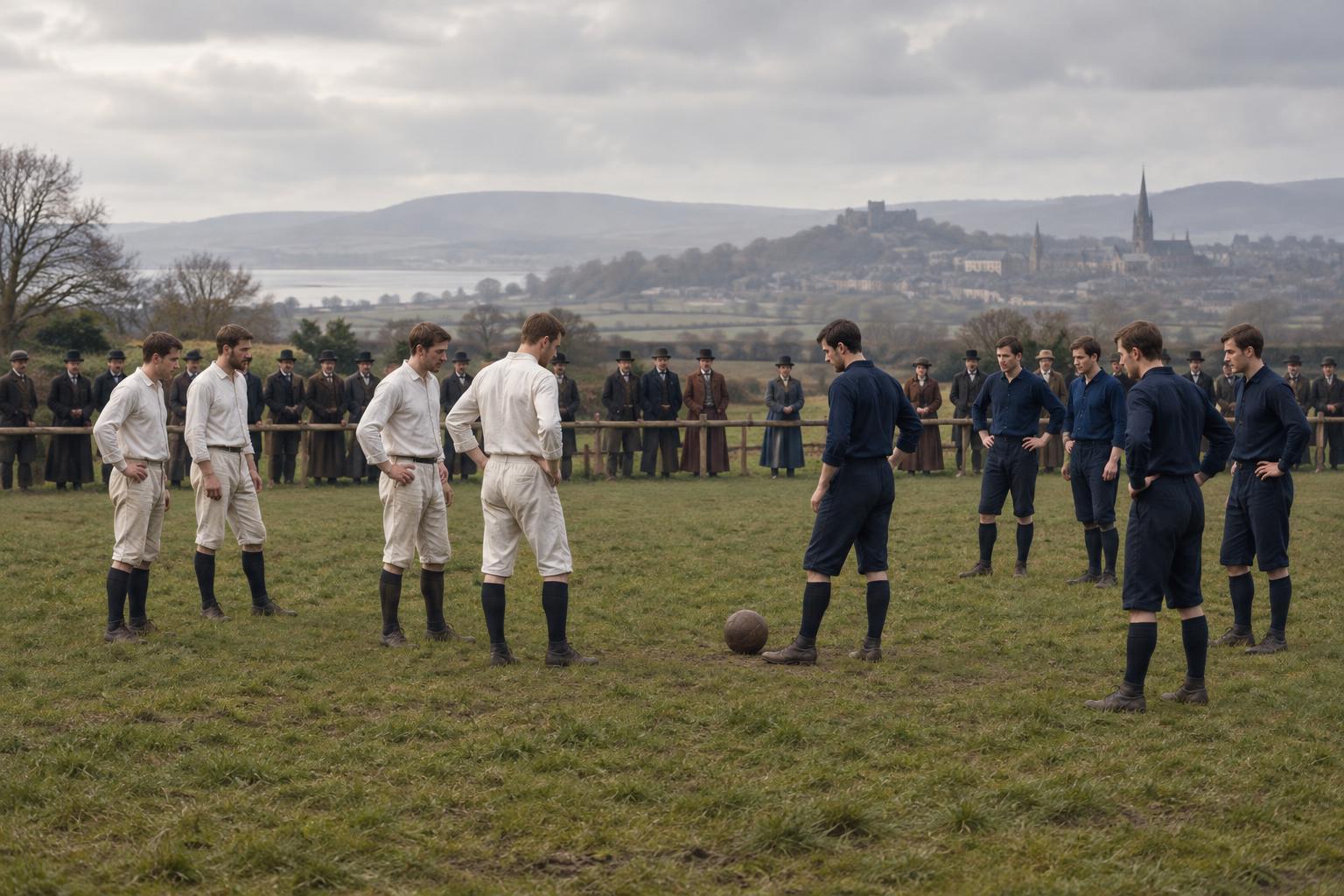
On 30 November 1872, Scotland and England met at Hamilton Crescent in Glasgow in the match widely recognised as the first official association football international. It ended 0–0. For an account of football history, the score is less important than what the fixture demonstrated: two sides selected to represent their countries could meet under agreed rules and produce a contest with an identity beyond either team’s clubs.
The match also revealed that there was no single way to play. Accounts of the fixture often contrast Scotland’s combination play with England’s more individual approach. Those descriptions should not be mistaken for fixed national traits, but they help explain why international matches became compelling. They offered a chance to compare footballing ideas as well as players.
A return fixture created a pattern
England hosted Scotland the following year. By arranging another match, the teams turned a one-off event into a rivalry that could be renewed. A return fixture gave supporters and organisers something to anticipate and gave each side another chance to measure itself against familiar opposition. That repeatability became central to national-team football.
Regular fixtures also required practical decisions. Organisers had to agree when and where to play, which rules would apply, and who would be eligible for selection. These questions could be difficult, especially while football’s governing structures were still developing. Yet each match helped make the next one easier to imagine. International football grew through this process of organising, playing and arranging to meet again.
From rivalry to a wider competition
England and Scotland did not remain the only representative sides. Wales played its first international against Scotland in 1876, and Ireland entered the international game in 1882. With four teams involved, the possibilities expanded beyond a single recurring pairing. A match could now be understood not only as a test against one rival, but as part of a broader comparison among national sides.
The British Home Championship, first contested in 1884, gave that comparison a competition structure. Instead of relying only on separate fixtures, teams could play within an organised series and be ranked by their results. This was an important step toward the familiar distinction between an international friendly and an international tournament. The early matches had established the participants and the appetite; the championship provided a format.
What the earliest matches left behind
The first internationals did not create every feature of the modern national team. Selection methods, tactics and competition rules continued to change, and football later spread far beyond the countries involved in those opening fixtures. Their legacy is more basic: they made it normal for a football side to represent a country, travel to face another and return for future contests.
They also gave supporters a new way to follow the game. Club allegiance remained important, but representative matches invited people to watch familiar players in a different setting and to care about how one football community compared with another. From an initial series of England–Scotland encounters came a durable framework: national sides, recurring fixtures, rivalries and, eventually, competitions built around them.