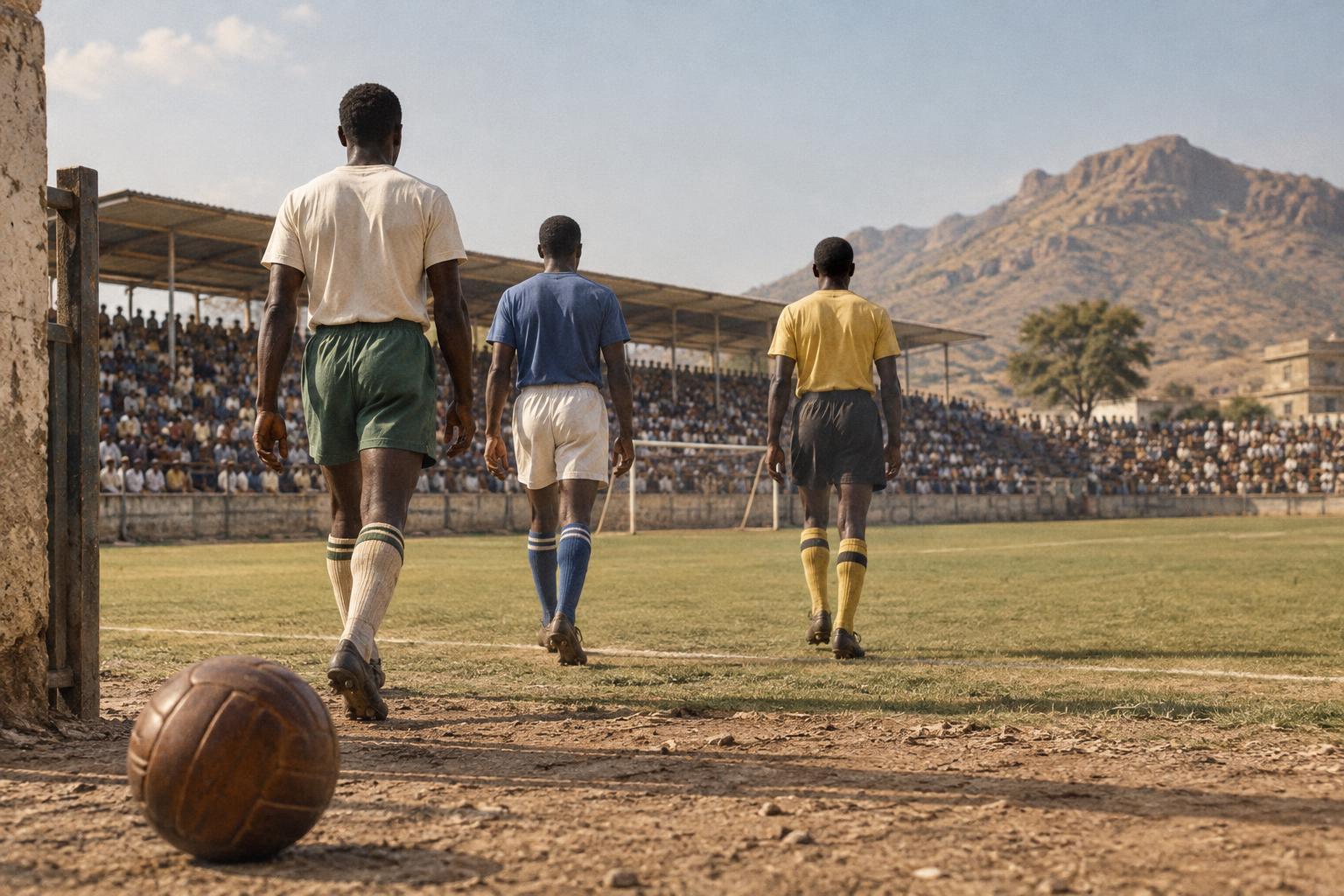
A continental competition takes shape
The Africa Cup of Nations, often shortened to AFCON, began as more than a new fixture on the football calendar. It offered African national teams a competition of their own and gave the continent’s football associations a shared project. Its first edition was held in Khartoum, Sudan, in 1957, the same year the Confederation of African Football, or CAF, was established.
That first tournament was small by any measure, but its scale reflected the circumstances in which it was created. Many African countries had yet to gain independence, and football administration across the continent was still developing. Organising a continental championship meant bringing together associations with different resources, travel challenges and political situations. The early AFCON was therefore both a football tournament and an exercise in building lasting connections between them.
Why only three teams played in 1957
Egypt, Sudan, Ethiopia and South Africa were associated with the plans for the first championship. Only Egypt, Sudan and Ethiopia took the field. South Africa was excluded amid a dispute over its apartheid-era policy of racial segregation and the composition of its proposed team. This was not a minor administrative detail: it showed that questions about who could represent a country, and on what terms, were present from the competition’s beginning.
With South Africa absent, Ethiopia advanced directly to the final. Egypt defeated host nation Sudan in the other match, then beat Ethiopia to become the first Africa Cup of Nations champion. There was no long qualifying campaign or group stage to resemble the later tournament. Just two matches decided the inaugural title, yet the event established a continental prize that other national teams could aspire to contest.
Football and a changing continent
AFCON’s beginnings are difficult to separate from the wider history of African self-determination. During the years that followed, more countries gained independence and developed national football associations. A national side could give supporters a visible symbol of collective identity, while matches against other African teams created sporting relationships beyond former colonial boundaries.
It would be too simple, though, to treat the tournament as a single political statement. Players, organisers and supporters also wanted the familiar things that make a championship compelling: a chance to compete, a trophy to win and performances to remember. Both dimensions matter. The competition grew because it provided a practical setting for international football, while its existence carried significance for a continent whose political map was changing.
From a small event to a broader championship
The first edition did not establish a fixed format. Early tournaments used different arrangements as the number of participating teams changed. Egypt won again in 1959, and Ethiopia claimed the title when it hosted in 1962. As more associations joined CAF and entered the competition, organisers had to find ways to accommodate a wider field.
That expansion changed the character of AFCON. A tournament that began with three competing sides gradually became a championship involving qualification and more varied opponents. Growth also brought new hosts, champions and football traditions into the story. Rather than emerging fully formed in 1957, the Africa Cup of Nations developed through successive editions as African international football gained a stronger organisational base.
What the first tournament still tells us
Looking back at Khartoum helps explain what makes AFCON distinctive. Its origin lies in the decision to create a competition for African nations despite limited infrastructure and major political obstacles. The exclusion of South Africa also makes clear that access to the tournament was bound up with arguments about racial equality, not simply results on the pitch.
The modern competition is far larger than its first edition, so the two should not be mistaken for the same kind of event. What connects them is the central idea: African national teams meeting in a championship organised within the continent’s own football structure. The 1957 matches supplied a modest starting point for that idea, and later generations of teams gave it a much bigger stage.